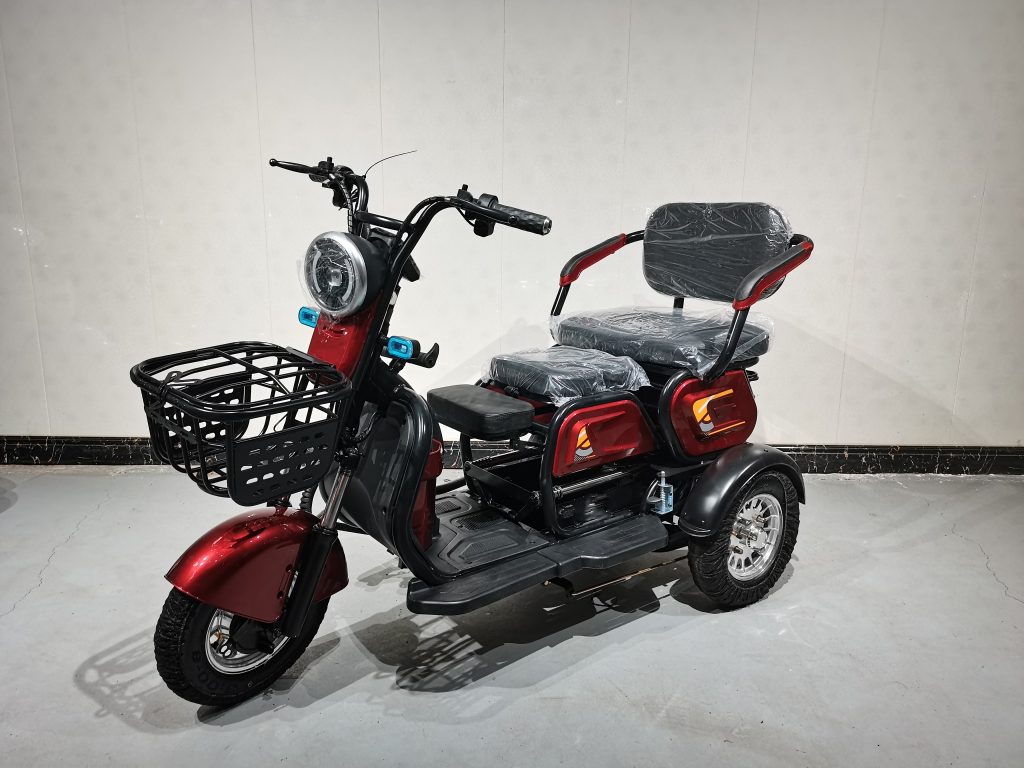
When people think of electric vehicles, cars and scooters usually come to mind. But quietly, a different kind of EV has been gaining ground worldwide — the electric tricycle, often called an e-tricycle or e-rickshaw.
Simple, durable, and surprisingly versatile, the electric tricycle is becoming a common sight on the streets of Asia, Africa, Latin America, and even parts of Europe and North America. But what exactly is an electric tricycle? How does it work? And why are so many people choosing it over motorcycles, tuk-tuks, or small trucks?
This article gives you a complete, easy-to-understand introduction to the electric tricycle.
What Is an Electric Tricycle?
An electric tricycle is a three-wheeled vehicle powered by an electric motor instead of a gasoline engine. It sits between a bicycle and a small truck in terms of size and capability.
Most e-tricycles feature:
- Three wheels for stability (no need to balance, unlike a motorcycle)
- A rear cargo bed or passenger seating area
- A handlebar steering system (like a bicycle or scooter)
- A rechargeable battery pack (lead-acid or lithium)
- A brushless DC electric motor (typically 500W to 2000W)
Unlike a car, an e-tricycle is light, narrow, and easy to maneuver in crowded city streets. And unlike a gasoline three-wheeler, it produces zero exhaust fumes and runs almost silently.
How Does an Electric Tricycle Work?
The system is surprisingly simple — which is one of its greatest strengths.
- Battery stores electricity – Charged from a standard wall outlet (110V–240V). A full charge takes 4 to 8 hours depending on battery size.
- Controller manages power – Acts like the brain of the system. When you twist the throttle, the controller sends the right amount of electricity to the motor.
- Motor turns the wheels – Most e-tricycles use a brushless DC motor. This motor either drives a chain to the rear axle (mid-mount) or is built directly into the rear axle housing (differential motor).
- Regenerative braking (on some models) – Recovers a small amount of energy when slowing down or going downhill.
There is no engine oil, no radiator, no exhaust pipe, no spark plugs. Fewer parts means fewer things to break.
Main Types of Electric Tricycles
Not all e-tricycles are the same. Different designs serve different purposes.
1. Cargo Electric Tricycle
- Design: Open or enclosed rear bed
- Payload: 300 kg to 800 kg
- Common uses: Parcel delivery, vegetable transport, furniture moving, waste collection
- Box size: Typically 1.5m to 2.5m long
2. Passenger Electric Tricycle (E-Rickshaw)
- Design: Rear seating for 4–6 passengers, often with a canopy roof and side curtains
- Payload: 4–6 adults plus driver
- Common uses: Short-distance public transport, school shuttles, tourist rides
- Features: Bench seats, handrails, sometimes a rear door
3. Flatbed / Multipurpose Tricycle
- Design: A completely flat rear deck with no fixed sides
- Payload: 400 kg to 600 kg
- Common uses: Building materials (cement, bricks, lumber), water tanks, mobile vending
- Advantage: Can be customized with stake sides, a cage, or a refrigerator box
4. Recreational / Personal Electric Tricycle
- Design: Smaller, often with a bicycle-style seat and rear basket
- Motor: 250W to 500W
- Common uses: Elderly riders, people with balance issues, grocery shopping, park cruising
- Note: These are common in Europe and the US, while cargo and passenger types dominate developing markets
Key Components of an Electric Tricycle
For anyone considering buying or importing e-tricycles, understanding the main parts is essential.
| Component | Function | Typical Specs |
|---|---|---|
| Motor | Converts electricity into motion | 500W, 800W, 1000W, 1500W, 2000W |
| Battery | Stores energy | Lead-acid (12V 45Ah–80Ah) or Lithium (60V 45Ah–100Ah) |
| Controller | Regulates power from battery to motor | 12-tube to 24-tube MOSFET controllers |
| Frame | Supports all components | Q195/Q235 steel tube, welded |
| Brakes | Stopping power | Drum brakes (rear), hydraulic disc brakes (front optional) |
| Tires | Grip and load capacity | 3.50–12, 4.00–12, 4.50–12, 5.00–12 |
| Differential | Allows rear wheels to turn at different speeds (on axle-drive models) | Steel housing with internal gears |
Advantages of Electric Tricycles Over Gasoline Alternatives
Why are so many people switching from gasoline tuk-tuks or motorcycles to e-tricycles?
✅ Lower Operating Cost
Electricity is far cheaper than gasoline. A typical e-tricycle costs $0.50–$1.00 per day to charge, compared to $4–$6 for gasoline.
✅ Minimal Maintenance
No oil changes, no air filters, no carburetor cleaning, no clutch replacement. Maintenance is limited to tires, brakes, and battery health checks.
✅ Quiet Operation
Near-silent running means night deliveries and early morning passenger trips do not disturb neighborhoods. It also makes conversation inside a passenger e-rickshaw much easier.
✅ Zero Tailpipe Emissions
No smoke, no smell, no carbon monoxide. This is better for the driver (who sits on the vehicle all day) and for pedestrians in crowded streets.
✅ Stable and Easy to Drive
Three wheels mean no balancing required. New drivers can learn in minutes. Elderly or less experienced riders feel safer than on two wheels.
✅ Simple Charging
Plug into any standard household outlet. No special charging station needed. Many owners charge overnight at home.
Limitations (Honest Facts)
No vehicle is perfect. Here are the real limitations of current e-tricycles:
- Range limits: Most e-tricycles can travel 50–90 km on a full charge. This is fine for city use but not for long highway trips.
- Charging time: 4 to 8 hours. Fast-charging options exist but reduce battery life.
- Battery replacement cost: Lithium batteries last 3–5 years but cost $300–600 to replace. Lead-acid is cheaper upfront but needs replacement every 12–18 months.
- Speed: Generally limited to 25–45 km/h for legal and safety reasons. Not built for highways.
- Climbing ability: On steep hills (over 15–20 degrees), a heavily loaded e-tricycle may struggle. A differential motor helps significantly.
Who Uses Electric Tricycles?
Today, e-tricycles serve a wide range of users:
- Delivery companies (parcels, food, e-commerce)
- Market traders (vegetables, grains, water bottles)
- Municipal services (street sweeping, waste collection)
- Public transport drivers (short urban routes)
- Farmers (taking produce to local markets)
- Street vendors (mobile kitchens, juice carts, coffee stands)
- Families (school runs, grocery shopping in older or developing communities)
- Tourist operations (beach towns, historical districts)
A Brief History – How Did We Get Here?
Electric tricycles are not brand new. Simple lead-acid battery powered trikes have existed in China since the early 2000s, where hundreds of factories perfected the design for low-cost, high-durability urban logistics.
Over the past decade, as lithium battery prices dropped by nearly 80%, e-tricycles became lighter, longer-lasting, and more practical. Today, China remains the world’s largest manufacturer and exporter, but demand is exploding across Africa, South Asia, the Middle East, South America, and even Southern Europe.
The Future of Electric Tricycles
Looking ahead, several trends will shape the next generation of e-tricycles:
- Swappable batteries – Instead of waiting hours to charge, drivers exchange a depleted battery for a fresh one at a battery station (similar to propane tank exchanges).
- Solar-assisted charging – Roof-mounted solar panels (100W–300W) extend range, especially in sunny climates.
- Smart connectivity – Basic GPS tracking and battery monitoring via mobile app.
- Stronger motors for hills – 3000W differential motors for truly mountainous regions.
- Cold chain versions – Insulated refrigerated boxes for dairy, meat, and medical supplies.
Is an Electric Tricycle Right for You?
If you are:
- A delivery business owner tired of fuel bills
- A driver looking to increase daily profit
- A municipal manager seeking quiet, clean service vehicles
- A farmer needing affordable produce transport
- Or simply someone curious about practical electric vehicles
…then the electric tricycle deserves a serious look. It is not glamorous. It does not go fast or far. But for the job it is designed to do — short-distance, load-carrying, low-cost urban mobility — nothing else comes close.